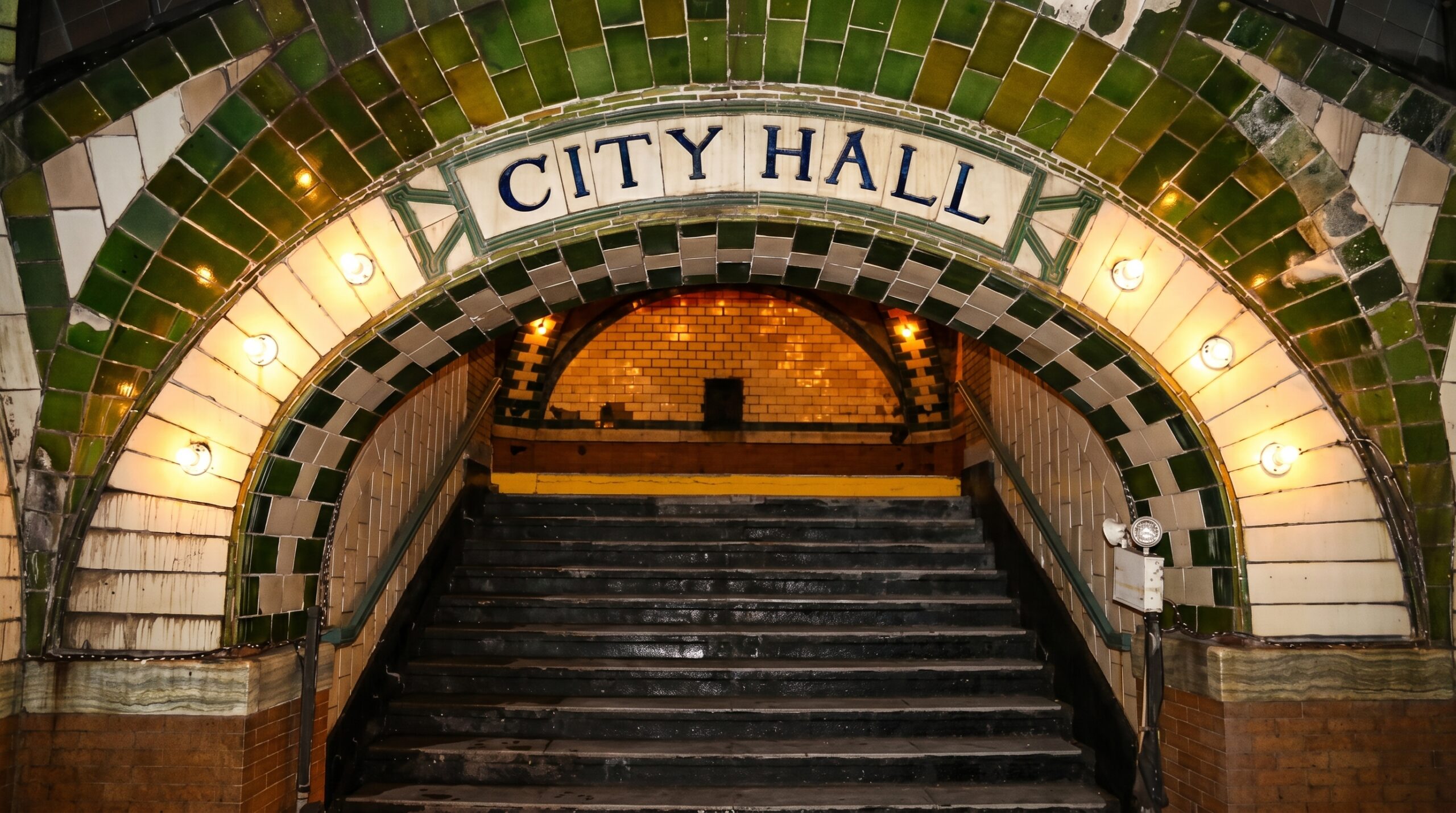
City Hall Station is not supposed to exist like this.
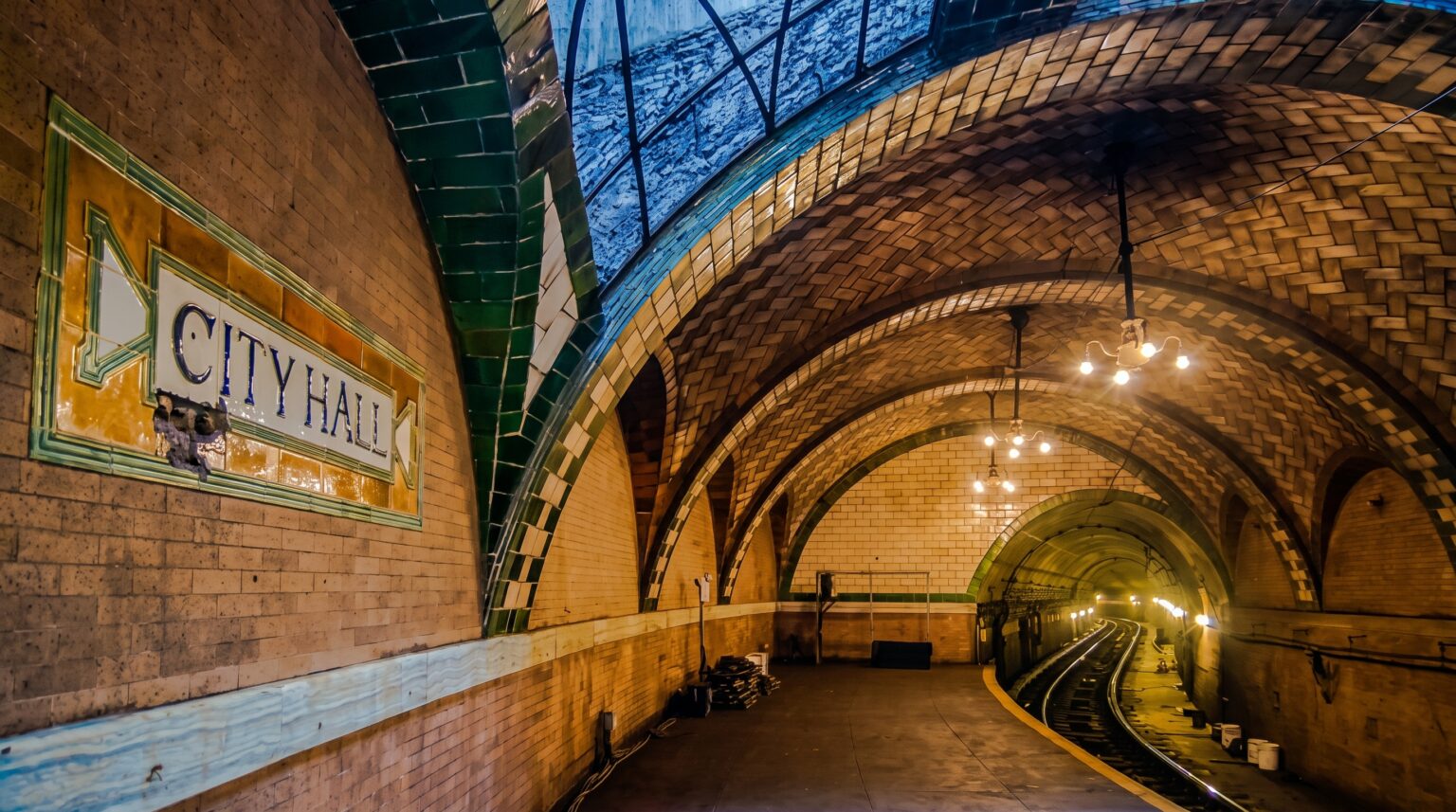
That thought hits you the moment you glimpse it — City Hall Station, curving away into the darkness like the spine of some magnificent forgotten creature.
Brass chandeliers, Guastavino tile vaults, Skylights dropping pale light into a station hidden beneath the political heart of New York City.
This place shouldn’t exist anymore. And yet.
A Mayor Wanted a Monument So They Built One Underground
Step back to March 24, 1900. Construction begins not in some industrial yard, not behind a chain-link fence — but on the front steps of City Hall itself. Deliberately. Symbolically. The mayor of New York City wanted something beautiful beneath his building, and he made sure everyone knew it.
This was never meant to be just a stop.
The Interborough Rapid Transit Company (IRT) was building more than a transportation system. It was building confidence. The first subway line needed a place that would make newspapers marvel, investors nod approvingly, and ordinary New Yorkers feel they were stepping into the future itself.
For that assignment, the city turned to Heins & LaFarge, the architectural firm responsible for shaping much of the new subway’s visual identity. They understood something many engineers did not: infrastructure could inspire awe just as effectively as any monument above ground.
To elevate the project even further, they enlisted Rafael Guastavino, the Spanish master of timbrel vaulting. By the turn of the century, Guastavino had already transformed some of America’s most celebrated public spaces, using interlocking tile vaults that were both elegant and remarkably strong.
The result was not a subway station. It was a civic theatre that happened to have tracks.
The Ambition Was Written into Every Stone
You have to understand the fever of that moment. The early 1900s transit boom wasn’t just engineering — it was ideology. Cities that built subways were cities that believed in themselves, cities that were leaning into the future at full speed.
New York was not going to build an ordinary entrance to that future.
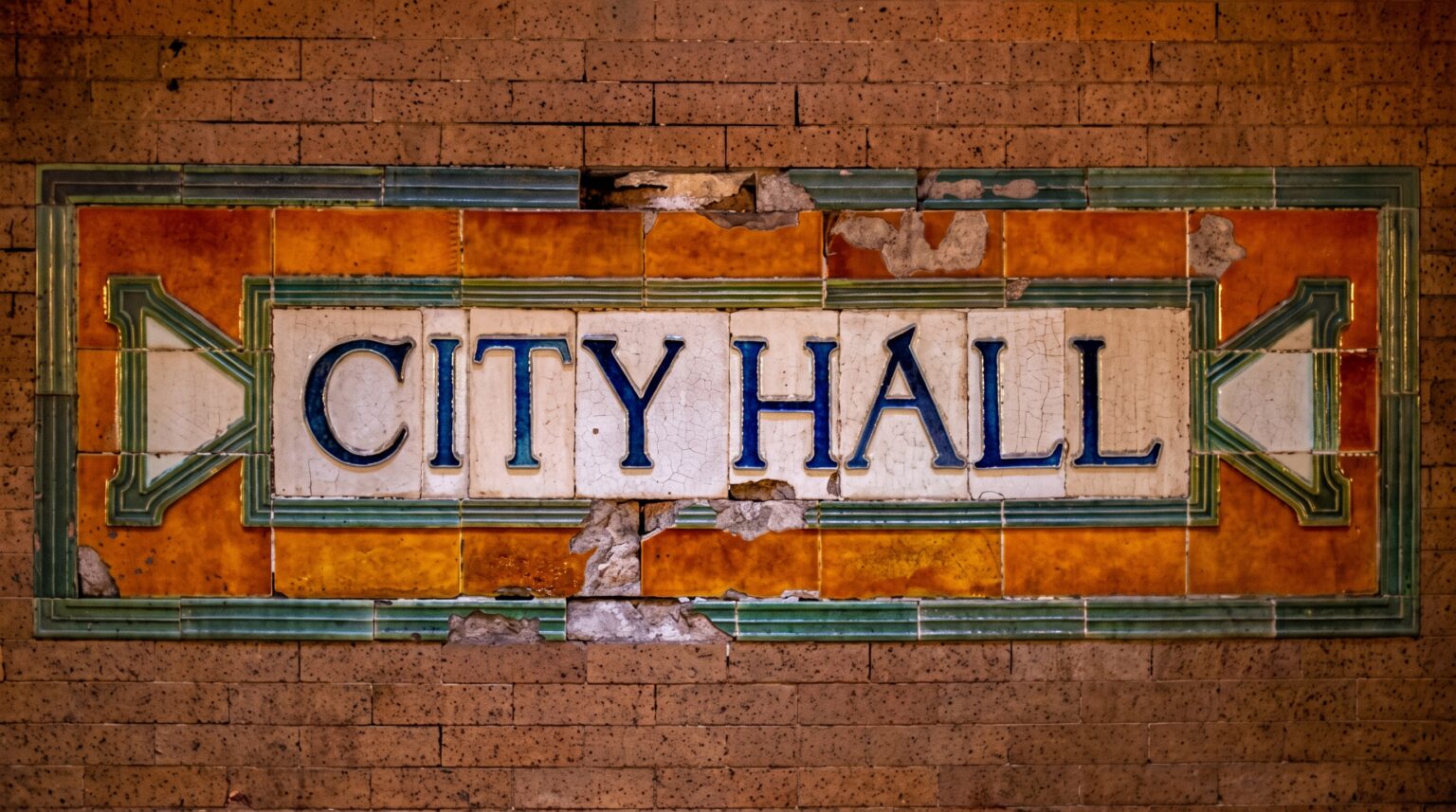
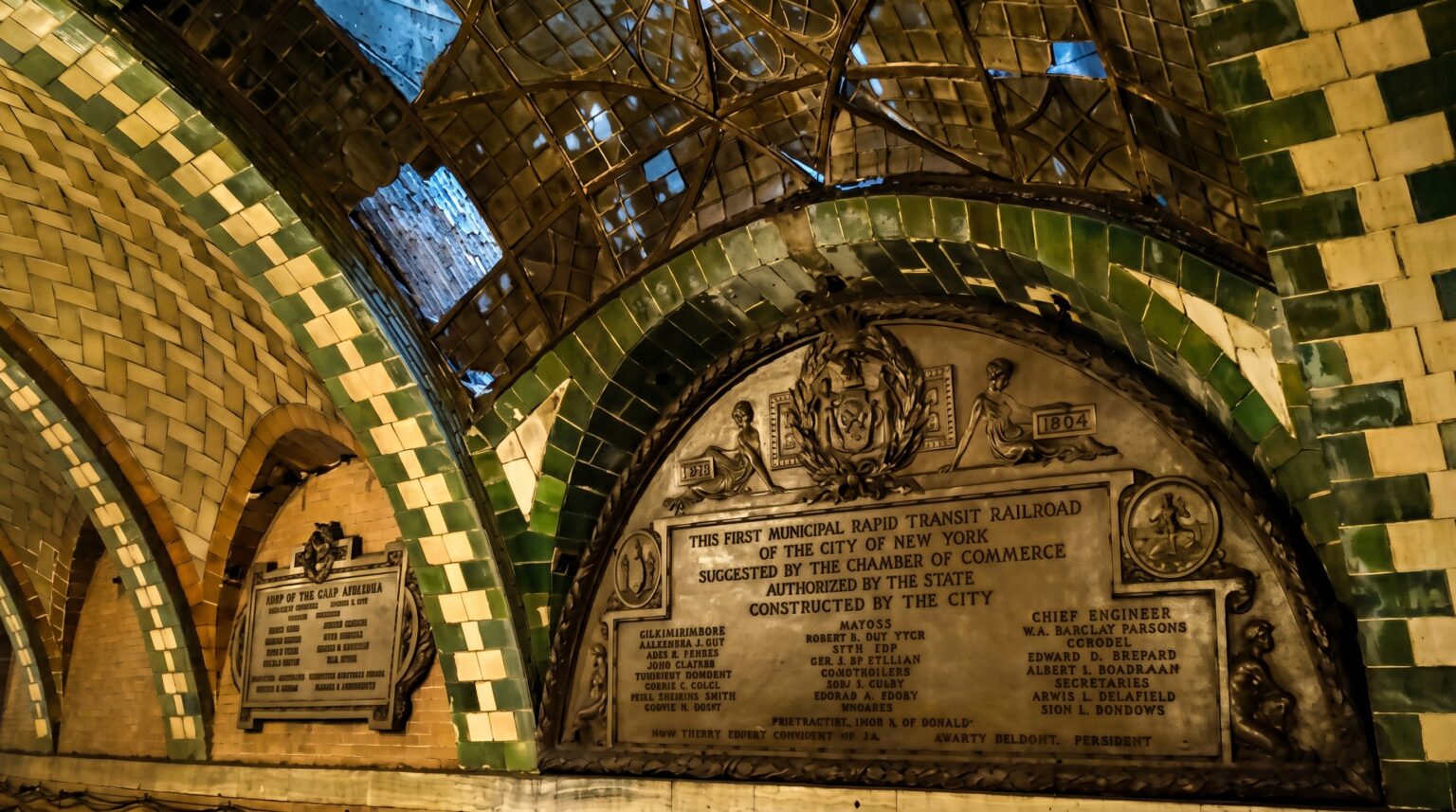
The station sat embedded beneath City Hall Park and Park Row, the most politically loaded ground in the entire city. Every design choice was a statement. Neo-Romanesque arches said- permanence. The ornamental plaques praising the builders said- pride. Ceramic tile — white, green, red, durable enough to outlast everyone who commissioned it, said- we intend to be here for a very long time.
On October 27, 1904, the subway opened. City Hall Station was its ceremonial heart.
Built to Impress, Not to Move You
City Hall Station: The Cathedral Below the Park
Stand Underneath It and Try Not to Feel Small
Walk the curve of the platform — if you’re lucky enough to be on one of the Transit Museum’s access tours — and the first thing that happens is your eyes go up. They always go up.
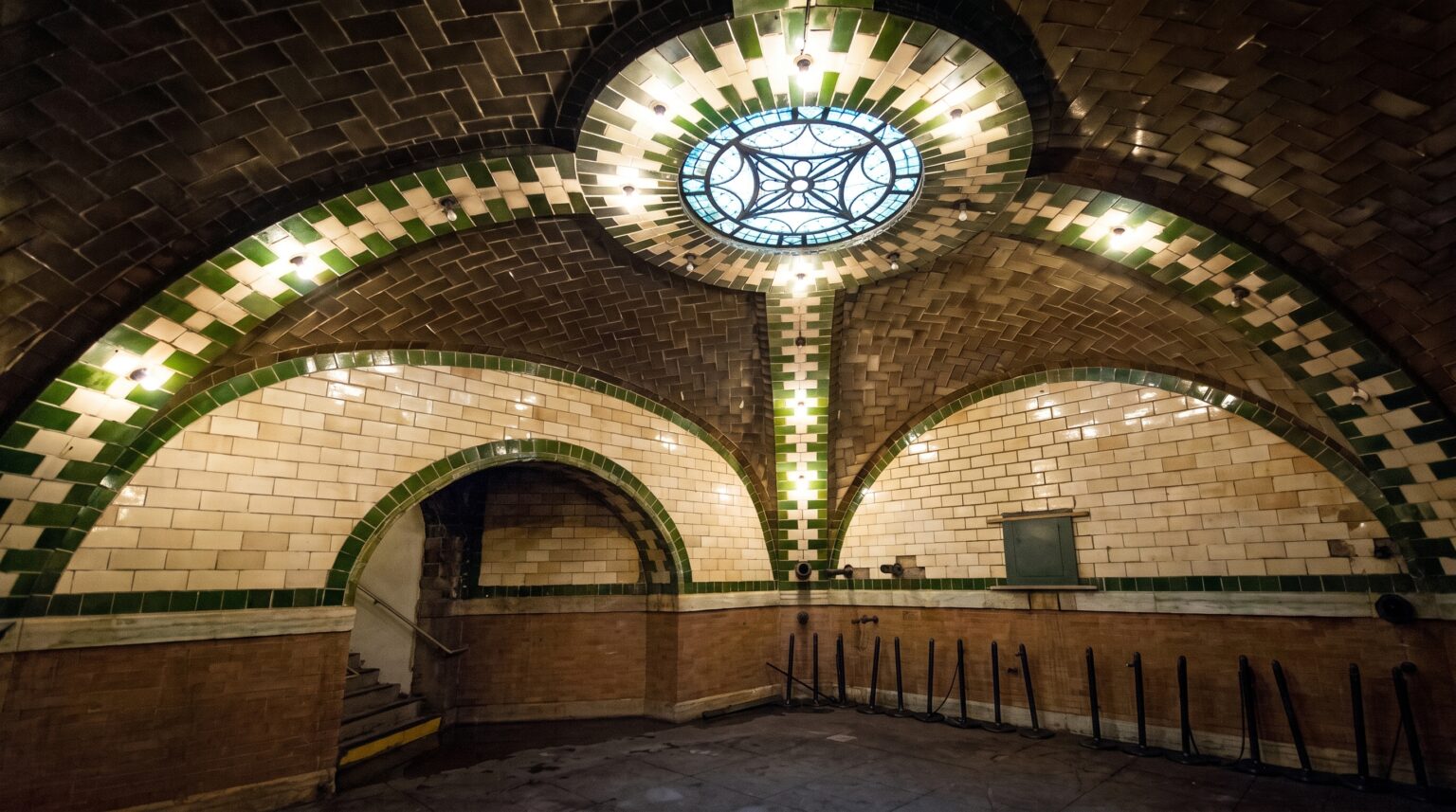
Twelve vaulted sections of Guastavino tile sweep overhead, following the station’s graceful curve like the ribs of a buried cathedral. The effect is immediate and almost involuntary. Your eyes go up before you realize you’re looking.
What makes the ceiling remarkable is not just its beauty but its engineering. Thousands of interlocking ceramic tiles distribute weight through geometry and compression, allowing the vaults to support themselves without hidden steel skeletons or massive structural supports.
More than a century later, those vaults are still doing exactly what they were designed to do. Through wars, closures, neglect, and changing administrations, the ceiling has endured — a stubborn masterpiece of architecture quietly holding its ground beneath the streets of Lower Manhattan.
Every Detail Was a Decision
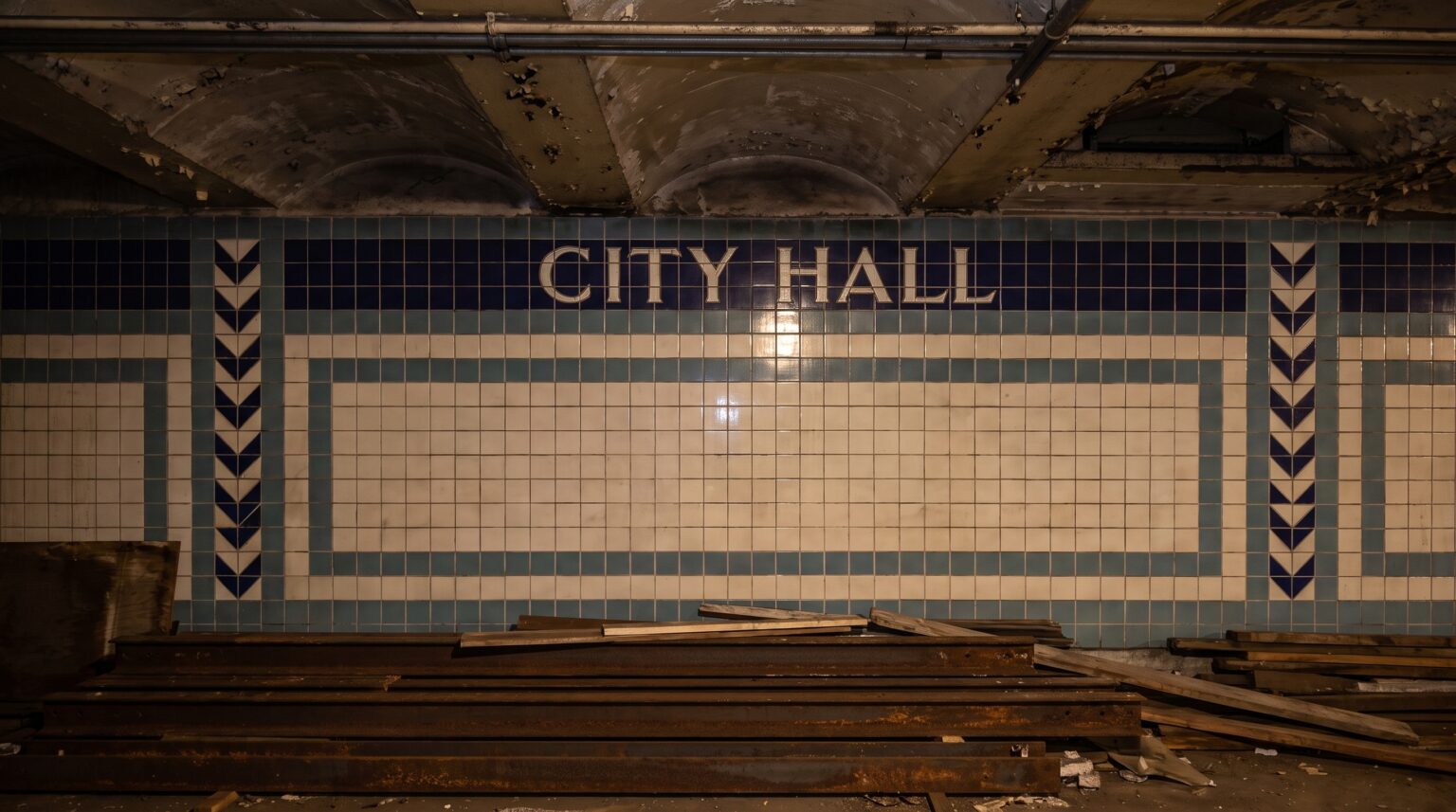
The brass chandeliers catch it first. Then the herringbone brickwork registers, tight and deliberate, the kind of pattern that takes time, that costs money, that nobody installs in a utilitarian space. Decorative ceramic plaques line the walls — not advertising, not wayfinding, but actual commendations, acknowledgments of the people who built the thing.
They built a place worth commemorating. And then they commemorated it.
The color palette alone — white tile, green trim, red accents, blue-tinted skylight glass — is more considered than most buildings constructed above ground in the same era. The mezzanine held leaded-glass details. The self-supporting vaulted ceiling elements meant the space could breathe, could feel open, even buried beneath tons of Manhattan earth.
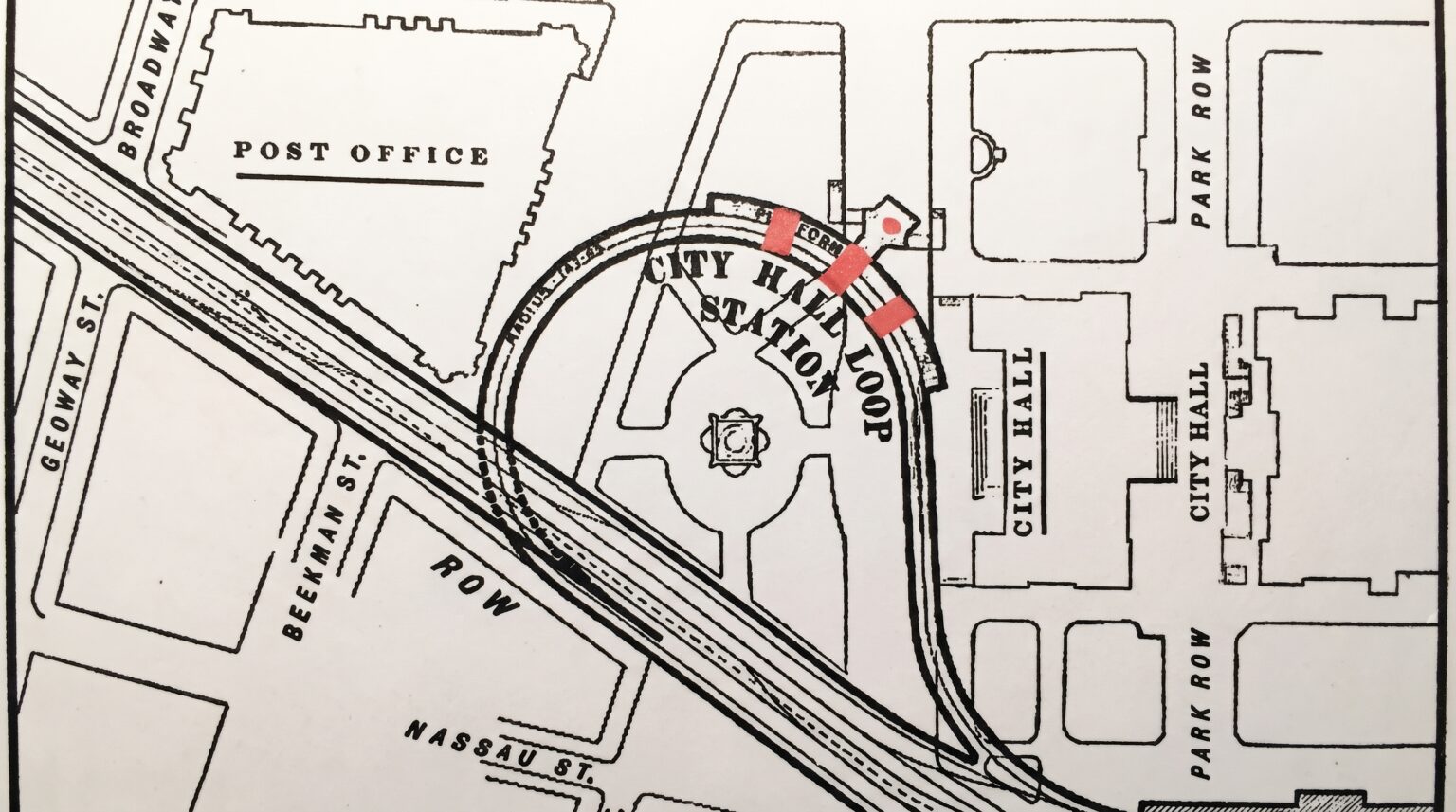
You run your eye along the single curved platform. Short. Elegant. A single loop track bending at a radius of 147.25 feet, engineered so local trains could terminate here without crossing the express lines. The geometry that makes it beautiful is the same geometry that eventually made it obsolete.
That’s the cruel irony sitting at the center of all of this.
The longer trains got, the wider the door gaps became on that elegant curve. By its final years of operation, City Hall Station was serving somewhere between 600 and 800 passengers a day — a ghost of a stop, beneath the ghost of an ambition, still architecturally magnificent, still completely intact, still waiting.
It closed on December 31, 1945. And it has barely changed since.
Why City Hall Station Was Forced to Close
Progress Didn’t Save It- Progress Killed It
The trains got longer.
That’s the brutal, almost absurdist punchline at the center of City Hall Station’s decline. The same elegant geometry that made architects gasp, that gave the space its cathedral sweep and its cinematic curve — that 147-foot radius became a death sentence the moment subway engineers started building bigger cars with doors in the center.
Stand at the edge of that platform in your mind and work it out. Longer car. Tighter curve. The door opens. And between the threshold and the platform edge, a gap yawns open — wide enough to catch a foot, wide enough to terrify, wide enough to kill the whole operational case for keeping the station running.
Six Hundred People a Day Wasn’t Enough to Save a Masterpiece
By the 1940s, the numbers were grim and getting grimmer. At its very best, in one of the peak years for New York subway travel, City Hall Station was pulling in around 600 passengers a day. Six hundred. In a city of millions. Beneath one of the most politically important parks on the Eastern Seaboard.
The nearby Brooklyn Bridge Station was right there, handling the same demand without the liability.
There were other indignities piling up quietly. The curve was loud — a grinding, metallic shriek as trains navigated the tight bend that rattled the tile and the chandeliers and the nerves of the few remaining daily riders. At certain hours, service was night-bypassed entirely in favor of the South Ferry Loop. The station had been reduced, in its final years, to a kind of operational embarrassment — too costly to fix, too dangerous to leave as-is, too beautiful to discuss rationally.
December 31, 1945, The last train cleared the platform. The entrances were sealed. The kiosks above in City Hall Park were pulled down and the street-level wounds were smoothed over, as if the whole thing had been a bad idea someone was now quietly tidying away.
The skylights went dark. And the city kept moving.
They Couldn’t Lengthen It, They Couldn’t Modernize It, so They Left It
What makes the abandonment feel almost violent is how permanent the architectural logic was. You couldn’t simply extend the platform — the curve geometry made that a structural impossibility. You couldn’t reroute the track without dismantling the loop that active trains still needed. Every solution cost more than the station was worth, operationally, and nobody in 1945 was making decisions based on Guastavino vaulting.
So they left it. Perfectly intact. Frozen.
The street-level entrances were sealed so thoroughly that today most New Yorkers who walk through City Hall Park have no idea what is directly beneath their feet. The skylights, those original punctures of daylight that once made the platform feel almost spiritual, were covered over. The brass chandeliers were left hanging in the dark, over a platform that no passenger would stand on again for decades.
You Can't Just Go: That's Exactly Why You Need To
The Grim and Gorgeous Reality of Visiting Today
Here is the truth, stated plainly, because you deserve it before you make plans: you cannot walk in off the street. There is no door. There is no staircase you can find if you look hard enough. The entrances sealed in 1945 stayed sealed, and City Hall Station today is legally and physically inaccessible by any independent route.
What you can do is ride the 6 train.
Take the downtown 6 to its terminal. As the train reaches the end of the line and loops back, it curves through the old City Hall Station geometry — through the actual space, the actual platform, the actual vaulted chamber. For roughly 30 to 45 seconds, if you position yourself at the rear window of the last car, the station slides into view around you. Dim. Intact. The tile catching what little ambient light filters through.
It is one of the strangest transit experiences in the United States.
Before you ride, do your homework. Untapped Cities has built one of the most thorough living records of City Hall Station’s secrets, updates, and rare access events — and their coverage is worth bookmarking alongside your Transit Museum membership page.
They broke the detail that the station surfaced back into public consciousness in 2025, when it was chosen as the setting for a mayoral swearing-in ceremony at midnight, proof that even the people running this city can’t fully resist what’s down there. That story alone tells you something important: this place is not dead. It keeps pulling the present back toward it, whether the city plans for that or not. Read their full deep dive at New York Transit Museum before you make the trip — then ride the 6 anyway, and see it for yourself.
The Rear Window Is Your Only Lens
This is where your “gear” becomes an interesting philosophical question. You don’t need a headlamp. You don’t need bolt cutters. You need a Metro Card and the clarity of mind to stay on the train when everyone else gets off at the Brooklyn Bridge stop.
Press your face to that rear window. Let your eyes adjust.
What you’ll see, for those few seconds, is a preserved ruin in motion — the arches still standing, the platform edge still there, the ghost of a station that the city walks over every single day without knowing. The light is low. The tile is old. The air in that space, according to everyone who has ever been granted authorized access, is cool and damp and smells like time itself, like wet stone and a century of darkness.
Cameras with fast lenses do better than phones here — the light is brutal and the window may not be clean and the train will not slow down for you. A wide aperture, a steady hand, and a willingness to take twenty bad shots to get one extraordinary one.
The Rarer Path: Authorized Access and the Long Game
The New York Transit Museum has run occasional official tours, and this is the legitimate path for anyone who wants to stand on that platform rather than pass through it at speed. Sign up for Transit Museum membership. Watch their event calendar obsessively. These tours are announced with limited capacity and they fill immediately, sometimes within hours.
The last significant public opening on record was October 27, 2004 — the subway’s 100th anniversary — when the station briefly opened for a VIP ceremony and a few hours of controlled public access before going dark again. There were plans in the 1990s to restore it as a Transit Museum satellite branch. Those plans were canceled. The station stayed closed.
That 2004 opening has not been repeated at anything like that scale since.
Lower Manhattan, City Hall Park, & Park Row: Mark It on Your Map Anyway
Even if you never get inside, standing above it matters.
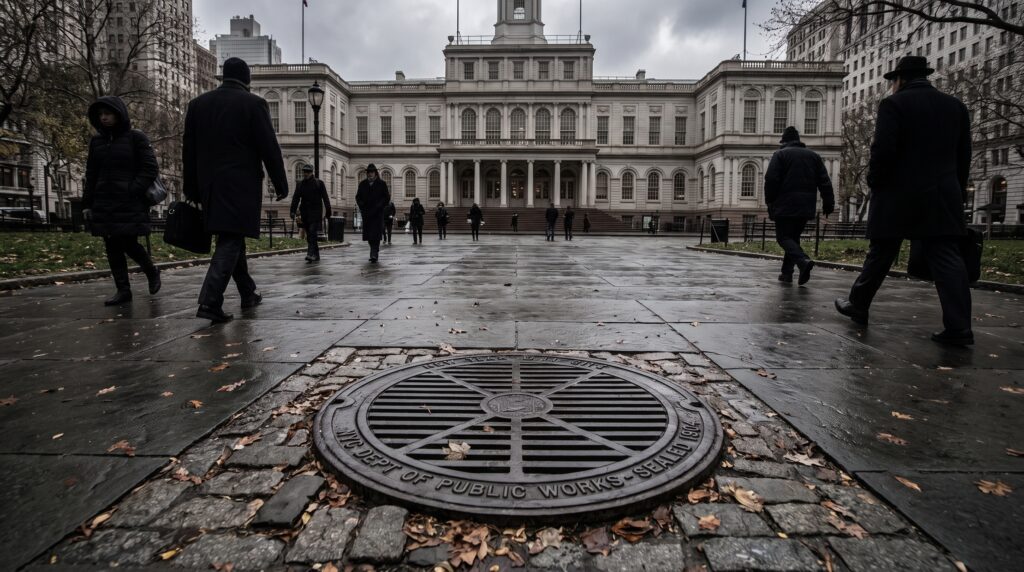
City Hall Park, at Park Row in Lower Manhattan — that’s the ground. Walk it slowly. Look down at the pavement where the old kiosk entrances once stood. Think about the fact that you are directly above a Guastavino vault, above brass chandeliers in the dark, above ceramic tile in white and green and red that has been sitting in perfect, untouched, underground stillness since Truman was in the White House.
The station is on the National Register of Historic Places now. A designation that protects it on paper while doing precisely nothing to open it to the people who would most appreciate it.
That tension — between preservation and access, between a city that knows it owns something extraordinary and refuses to fully share it — is the thing that will sit with you long after you’ve come up from the subway and stepped back into the noise of Lower Manhattan.
City Hall Station is not a ruin. It’s a room that’s been waiting. Quietly, in the dark, under a park, under a city, under a century of decisions made by people who had other priorities than beauty.
It’s still waiting now.
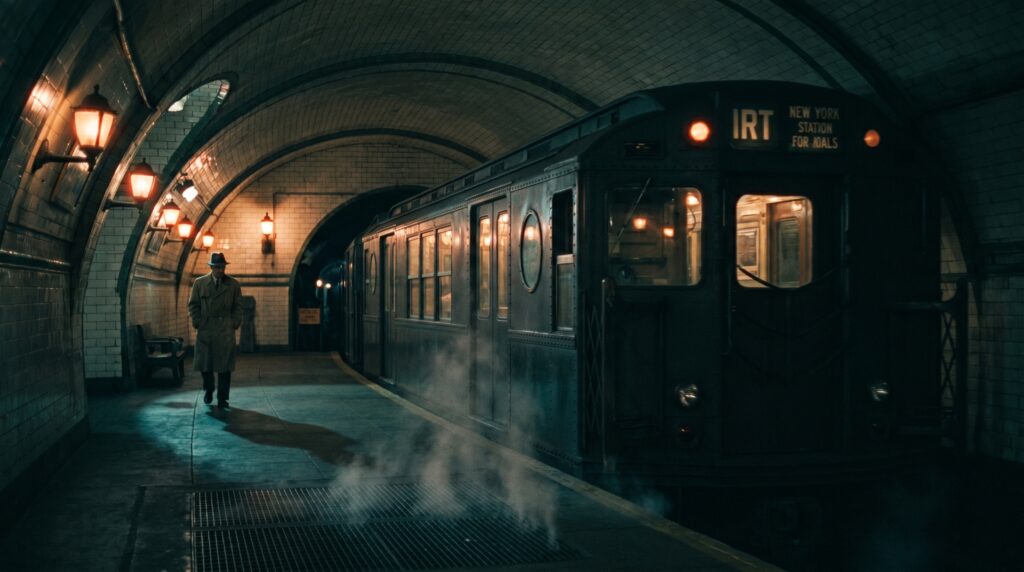
Is City Hall Station New York's Greatest Lost Landmark?
Some places fail loudly. They burn, they collapse, they get bulldozed for a parking lot and a bad mural. City Hall Station did something quieter and, in its own way, more haunting — it simply got left behind by the very thing it was built to celebrate.
Progress moved on. The station didn’t.
What remains beneath City Hall Park is not a ruin in the traditional sense. There is no dramatic collapse, no vegetation forcing its way through cracked concrete, no graffiti-covered decay that urban explorers typically travel hundreds of miles to find.
Instead, what survives is something far rarer. City Hall Station exists in a state of near-perfect suspension, preserved almost exactly as it was when the city decided it was no longer practical. The brass chandeliers still hang. The Guastavino vaults still arch overhead. It feels less like an abandoned space than a grand room waiting for guests who stopped arriving generations ago.
That is what makes the station so unsettling. Most abandoned places tell a story of destruction; this one tells a story of indifference. It was built to make people believe in New York’s future, then quietly sidelined by the same relentless progress it was designed to celebrate. More than eighty years later, it remains beneath the park in almost complete darkness, dressed for a ceremony that never resumed.
It was built to make people believe in New York. It was abandoned because New York stopped believing it was worth the trouble.
That’s the tragedy that sits at the center of all of it — not the closure, not the sealed entrances, not even the canceled restoration plans. It’s the ordinariness of the decision. Six hundred passengers a day. A dangerous gap at the platform edge. A newer station nearby. A cost-benefit analysis written on a Tuesday in 1945, by people who almost certainly did not pause to look up at the vaulting before they signed the paperwork.
And now it waits. Beneath the park. Beneath the politicians. Beneath the pigeons and the tourists and the food cart vendors who have no idea they are standing above one of the most beautiful underground chambers ever built in the United States.
The question that follows you back up to street level, blinking in the daylight, is this: if a city can build something this extraordinary and then simply forget it exists — what else is it walking over without looking down?
Bookmark and subscribe to roastedbum.com to get more updates on astonishing historical deep dives.