Duga Radar: A Giant Rises From the Pines
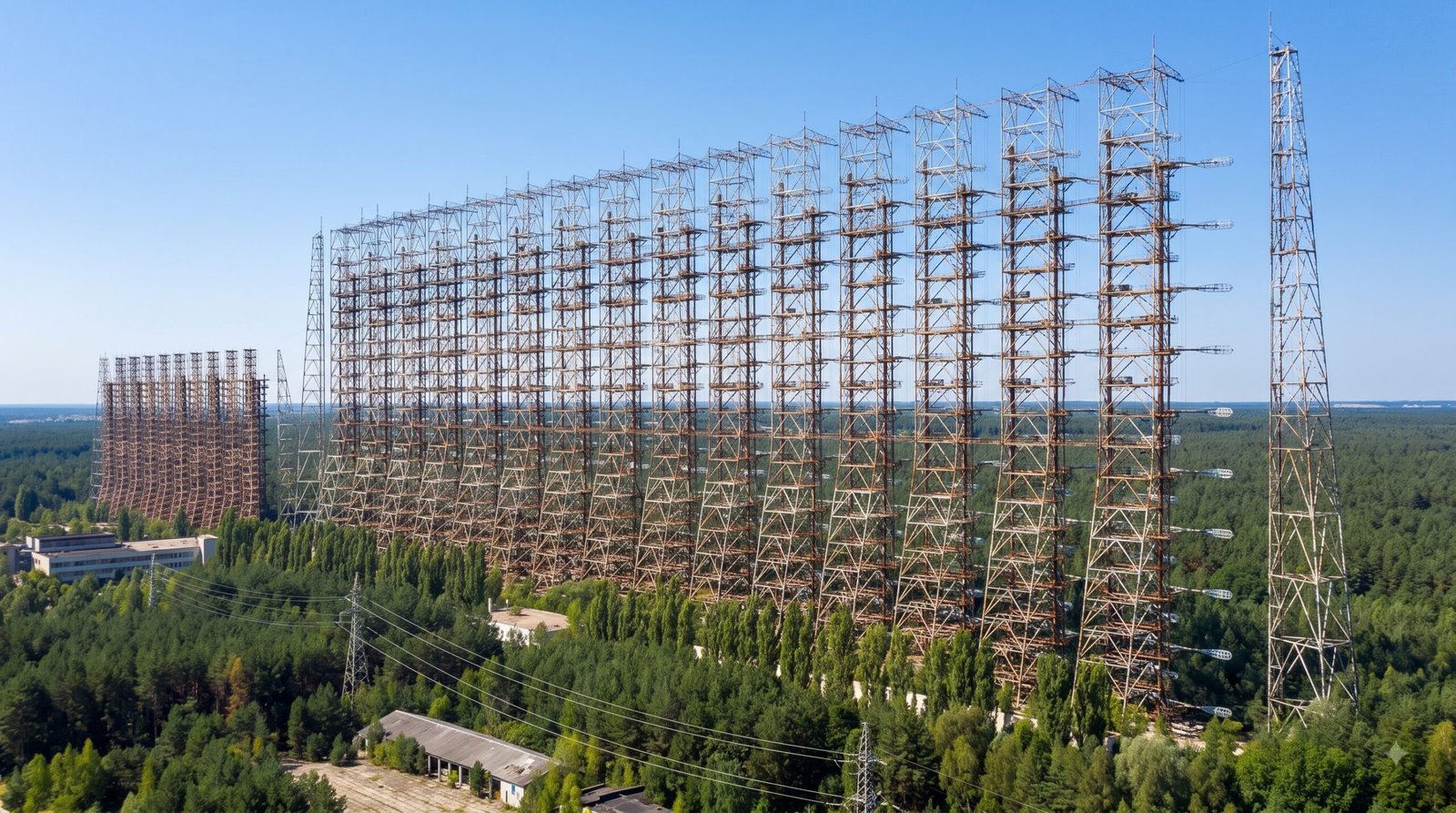
You hear it before you see it. A hum in the ground, rising through dead pine needles and cracked concrete. Then the trees break, and the Duga Radar swallows the sky whole.
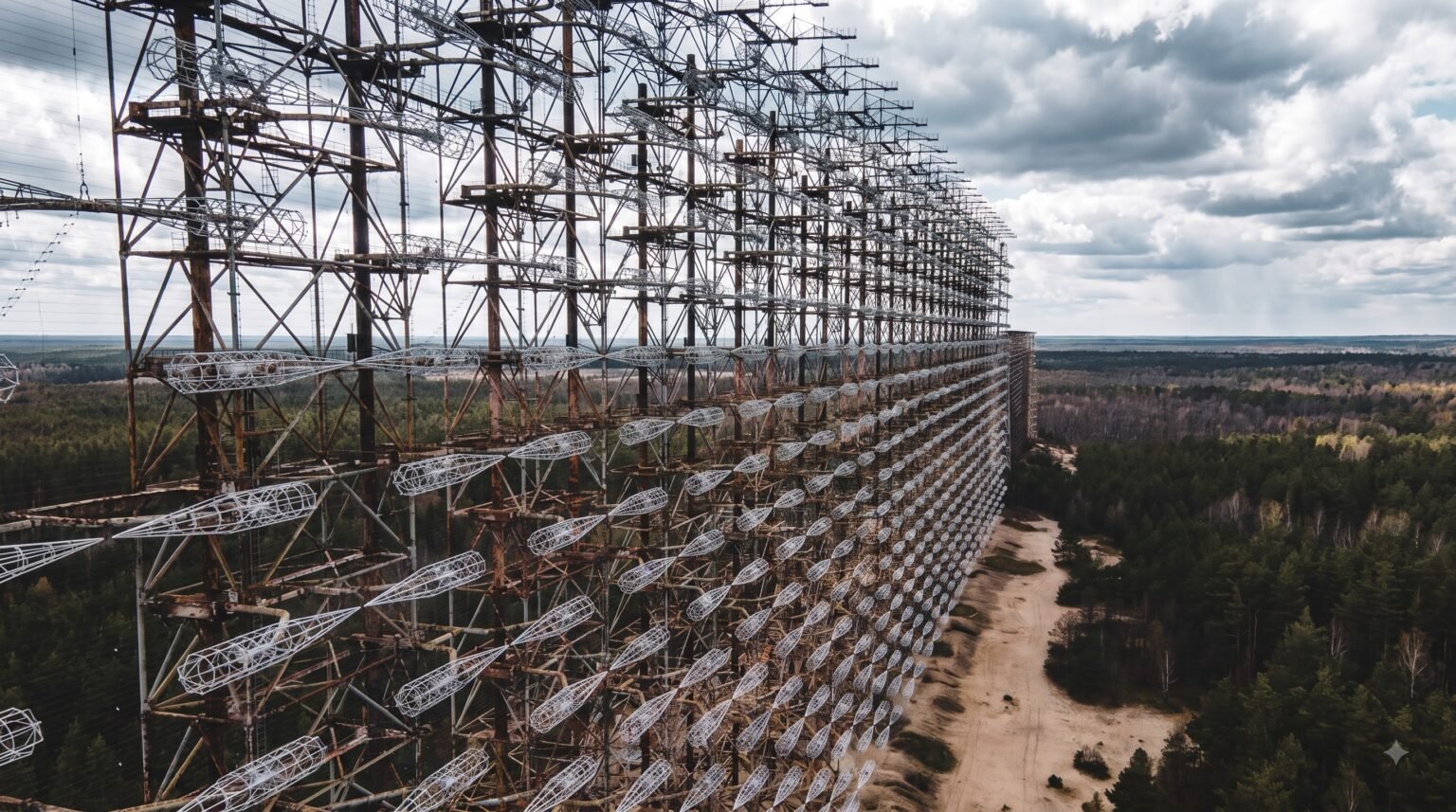
150 metres of rusted steel lattice, climbing straight out of the Chernobyl Exclusion Zone.
Your brain reaches for something familiar to compare it to. A bridge, maybe. A radio mast.
It comes up empty every single time. Nothing else on Earth looks quite like this.
For over a decade, this exact structure sat at the center of a mystery that spanned continents. Starting in the 1970s, a harsh, rhythmic tapping clawed its way into shortwave frequencies from Tokyo to Texas.
It drowned out amateur radio operators. It bled into aviation channels and commercial broadcasts.
It tangled utility crews mid-sentence, mid-instruction, mid-emergency.
Nobody outside a tight circle of Soviet engineers knew where the noise came from. Rumors filled the silence instead — mind control, weather control, weapons nobody could name.
The rest of the world settled on something simpler: the Russian Woodpecker.
NATO‘s analysts, piecing together grainy satellite photographs of Soviet military buildups, had their own designation for this place. STEEL YARD, sometimes logged as STEEL WORK.
Cold. Clinical. Accurate.
Stand here now, and you’re standing inside one of the strangest ghost stories of the entire Cold War.
Quick Facts
- Location: Chernobyl Exclusion Zone, Ukraine
- Built: Early 1970s
- Operational: 1976–1989
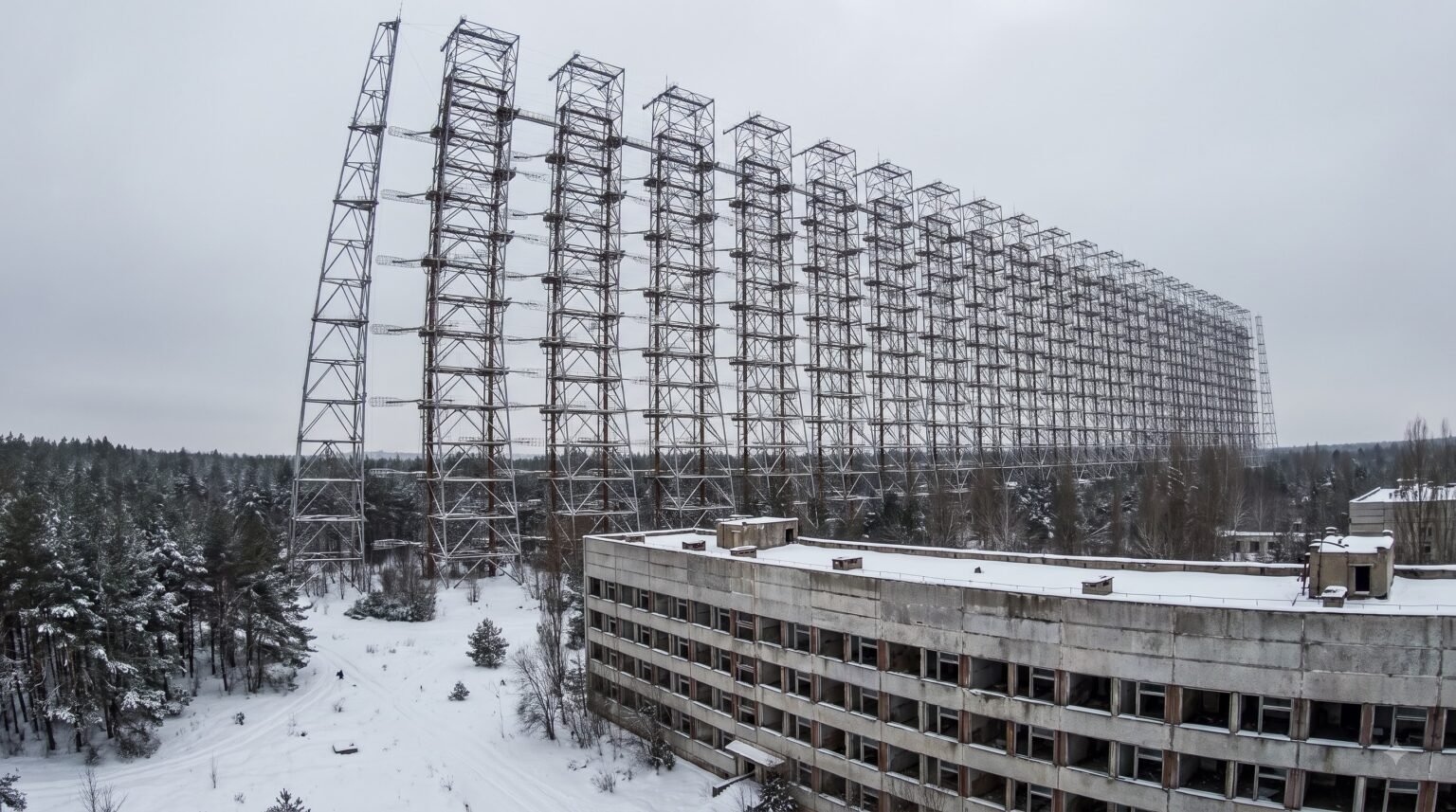
- Height: Approximately 150 metres (492 ft)
- Length: Approximately 700 metres (2,300 ft)
- Purpose: Soviet over-the-horizon early warning radar
- Associated Settlement: Chernobyl-2
Current Status: Abandoned; public access currently suspended
Racing a Threat No Radar Could Catch
Step back to the late 1960s. The Soviet Union is staring down a timer it cannot see.
American intercontinental ballistic missiles could reach Soviet soil in under thirty minutes.
Existing ground radar only looked in straight lines, boxed in by the curve of the Earth itself. By the time a missile crossed into view, half the warning window had already burned away.
Early satellite coverage was still too fragile to close that gap.
What Soviet planners needed sounded closer to science fiction than engineering: a way to bend radio waves off the Ionosphere, curving them over the horizon to catch a launch in its opening seconds.
That idea had a name. Duga.
You can trace the first real test to a quiet stretch of land outside Mykolaiv, in southern Ukraine. Engineers built an experimental array there as pure proof of concept.
When it picked up rocket launches from the Baikonur Cosmodrome, nearly 2,500 kilometres away, theory became fact. Over-the-horizon radar worked.
That single success set everything else in motion. A fully operational system, hardened and hidden, aimed at the missile corridors of the West.
A City Built to Keep a Secret
To build the operational version, Duga-1, engineers split the system into two sites roughly 60 kilometres apart.
One transmitted. The other listened.
The northern site, close to the town of Chernobyl, became the true heart of the program. In time, people would simply call it Duga-3, the full production model of everything Mykolaiv had already proven.
Around the radar grew something else entirely; a settlement called Chernobyl-2, printed on no public map.
Behind its checkpoints lived a closed community of engineers, technicians, and their families. All cleared to work inside a facility most of the country never knew existed.
You could live two towns over your entire life and never learn what stood behind that fence.
One detail decided the location as much as any military strategy ever could power. Running Duga demanded tens of megawatts, more than most Soviet infrastructure could spare.
The solution hummed quietly a few kilometres away. The Chernobyl Nuclear Power Plant.
Two facilities. One shared appetite for electricity.
In the 1970s, that arrangement looked like nothing more than smart planning.
The Duga Radar: A Structure Built to Swallow the Horizon
Walk the old receiver field today, and the numbers stop making sense.
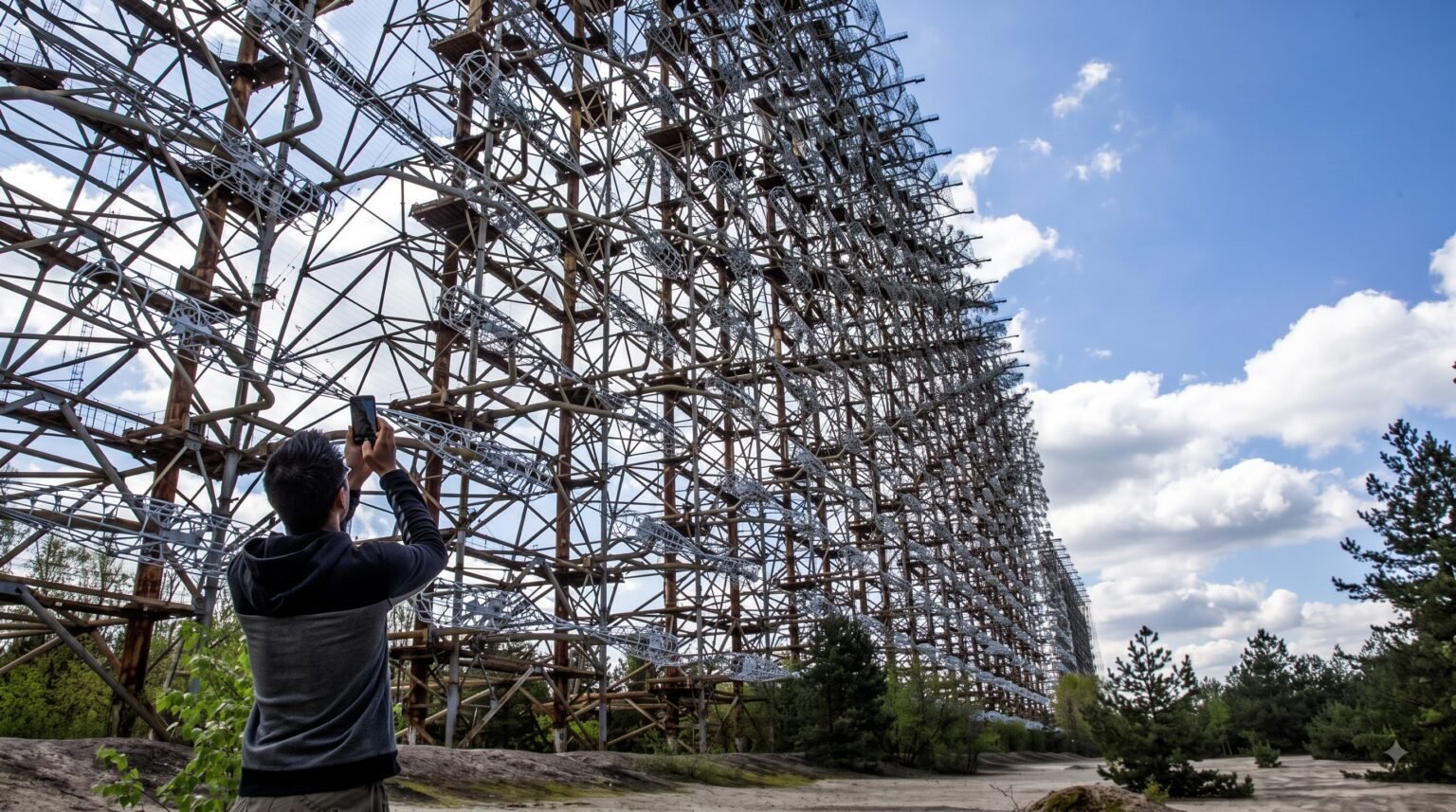
NATO‘s own assessment put the main antenna array at roughly 700 metres long, climbing to about 150 metres at its tallest.
Picture a line of football pitches stretching nearly three-quarters of a kilometre. Now stand something close to the height of the Great Pyramid of Giza at one end of it.
That’s the scale surrounding you here.
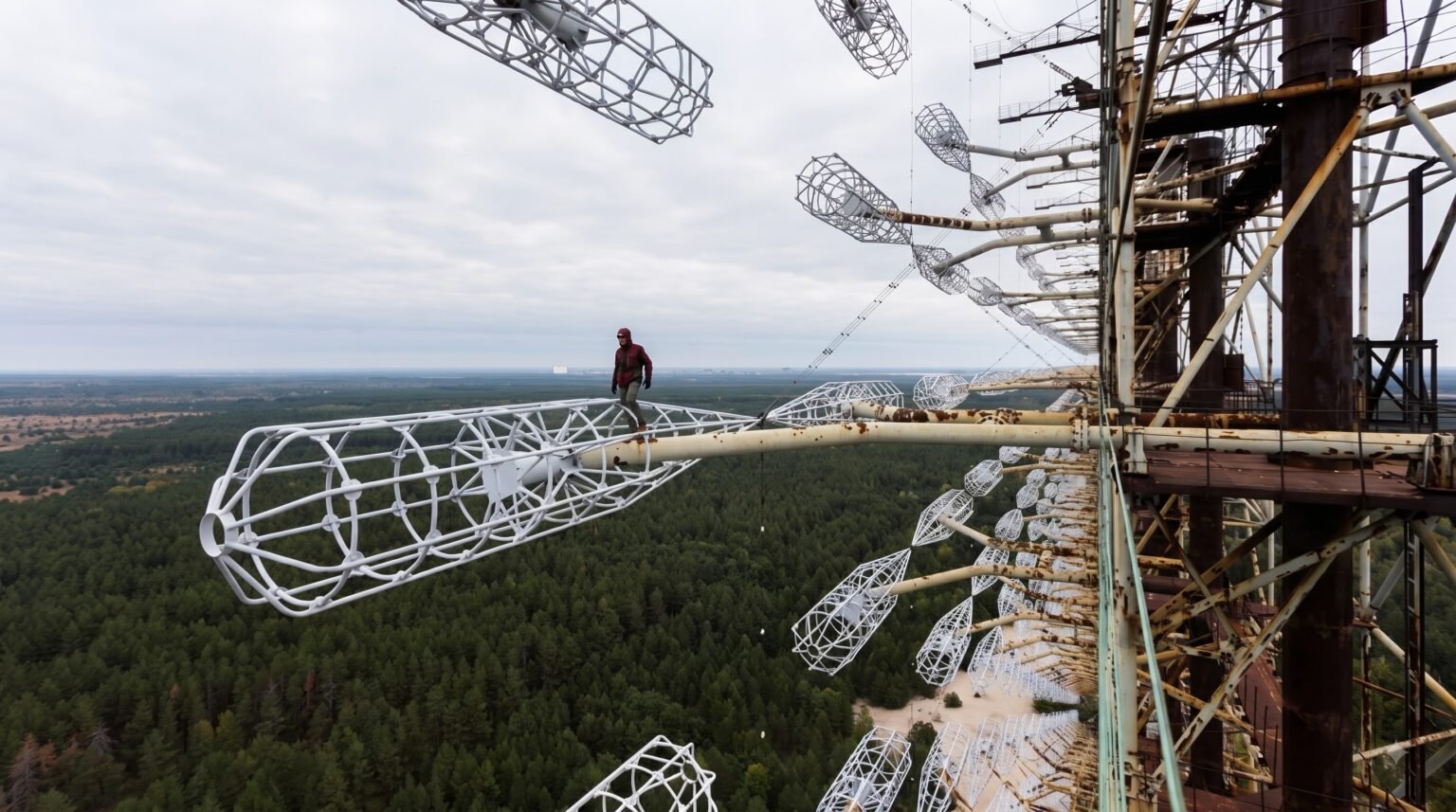
Two separate receiver antennas share this field, not one. A colossal low-frequency array climbs close to 450 feet into open air.
Beside it, only slightly smaller, a high-frequency array reaches roughly 270 feet. Together, the two structures stretch across nearly 2,200 feet of steel.
Somewhere past the treeline sits a third piece of the puzzle: a dedicated transmitter complex, doing the other half of the radar’s job.
Kept far enough away to stop the signals from drowning each other out.
Reading the Skeleton of the duga radar
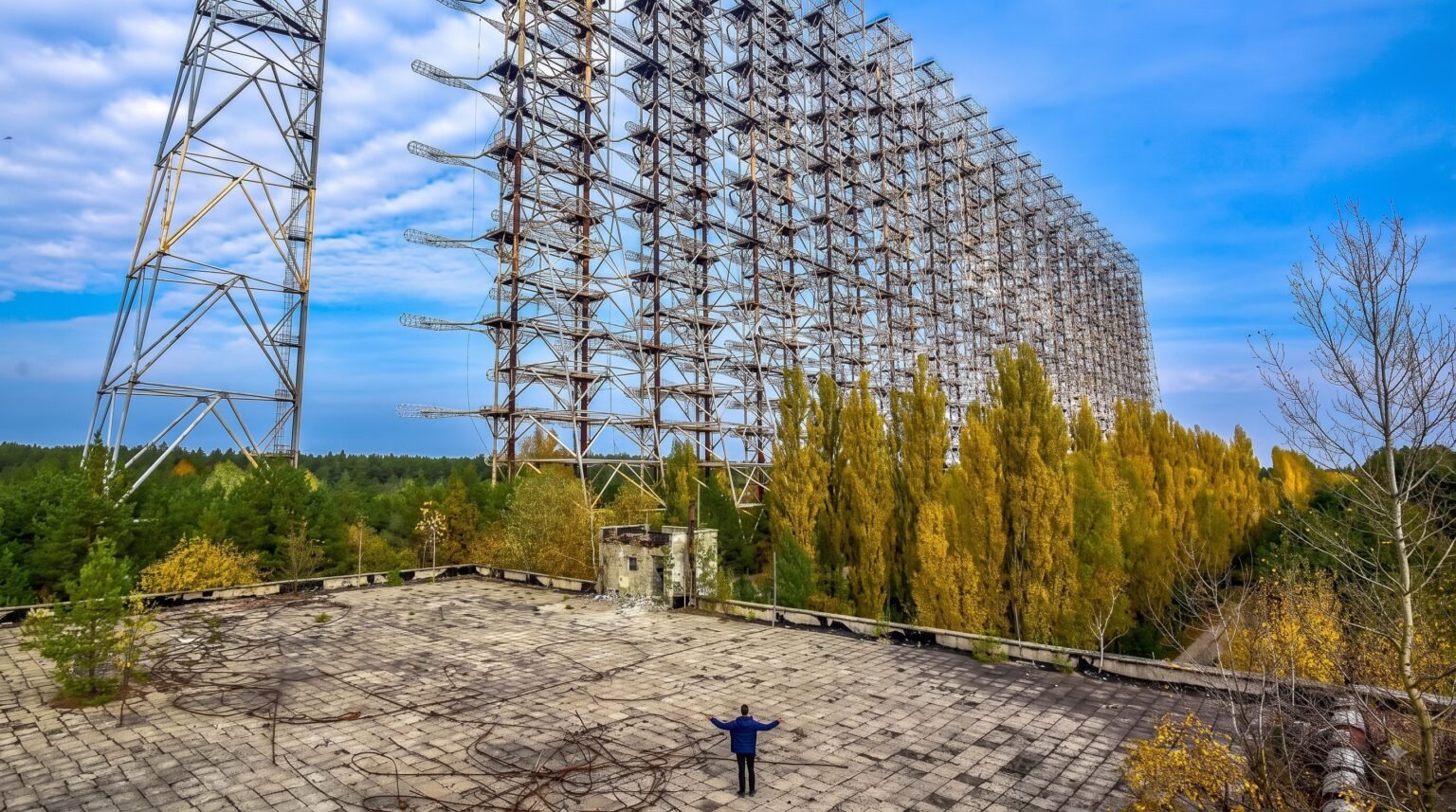
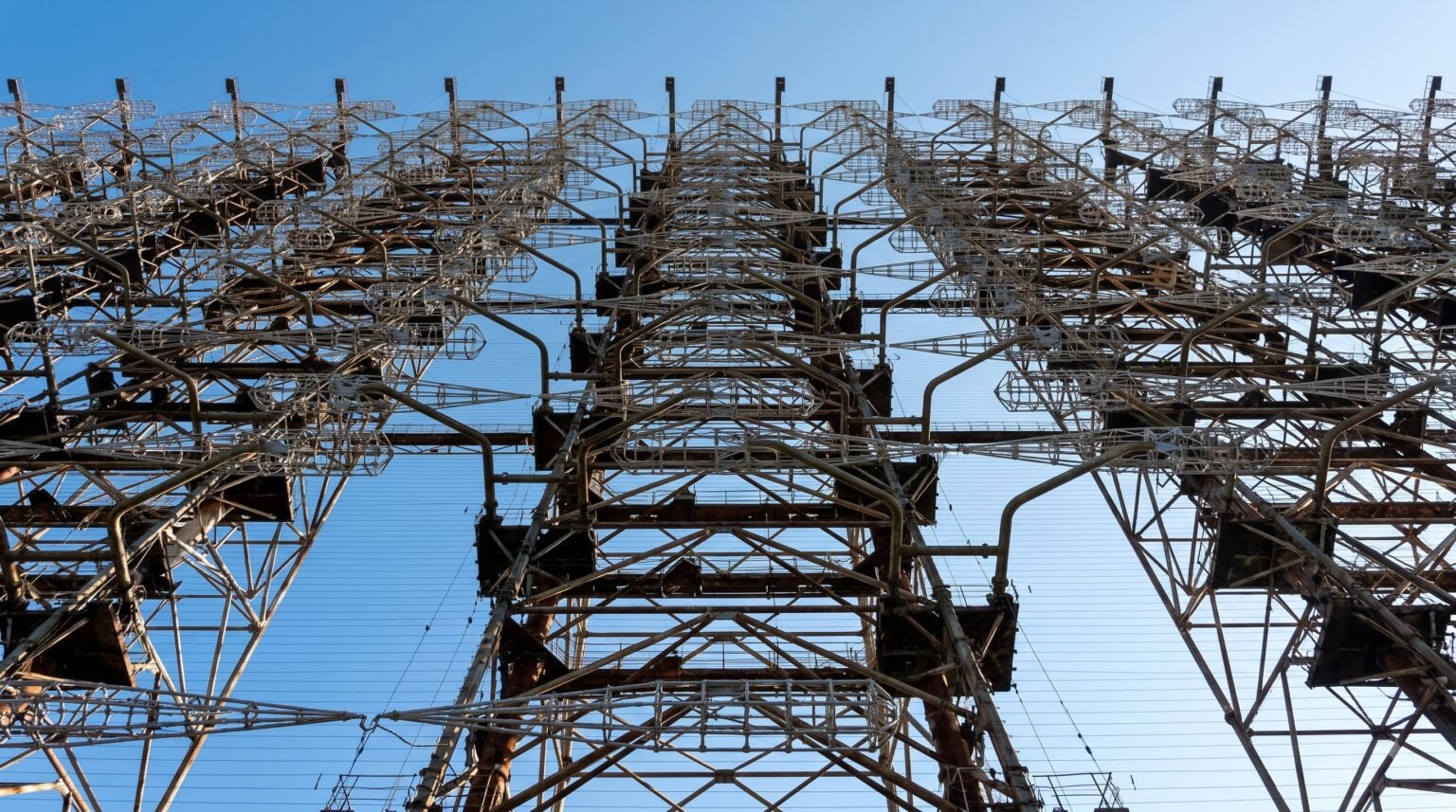
Look closely at the Duga Radar framework, and a pattern starts to emerge. Long rectangular sections stack toward the sky.
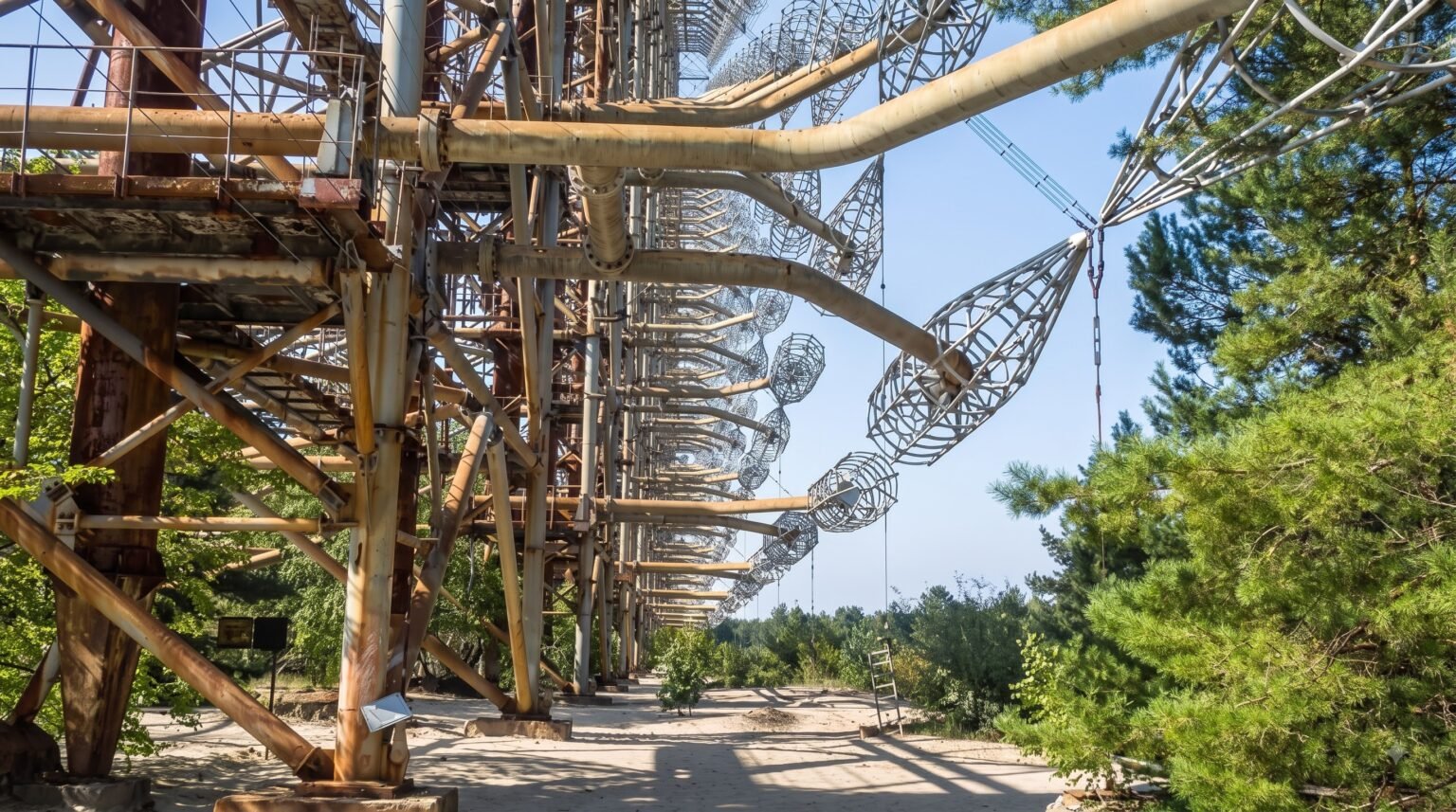
Massive end pylons anchor each corner like the legs of some collapsed bridge. Row after row of horizontal cable stretches between support towers, disappearing into the haze above you.
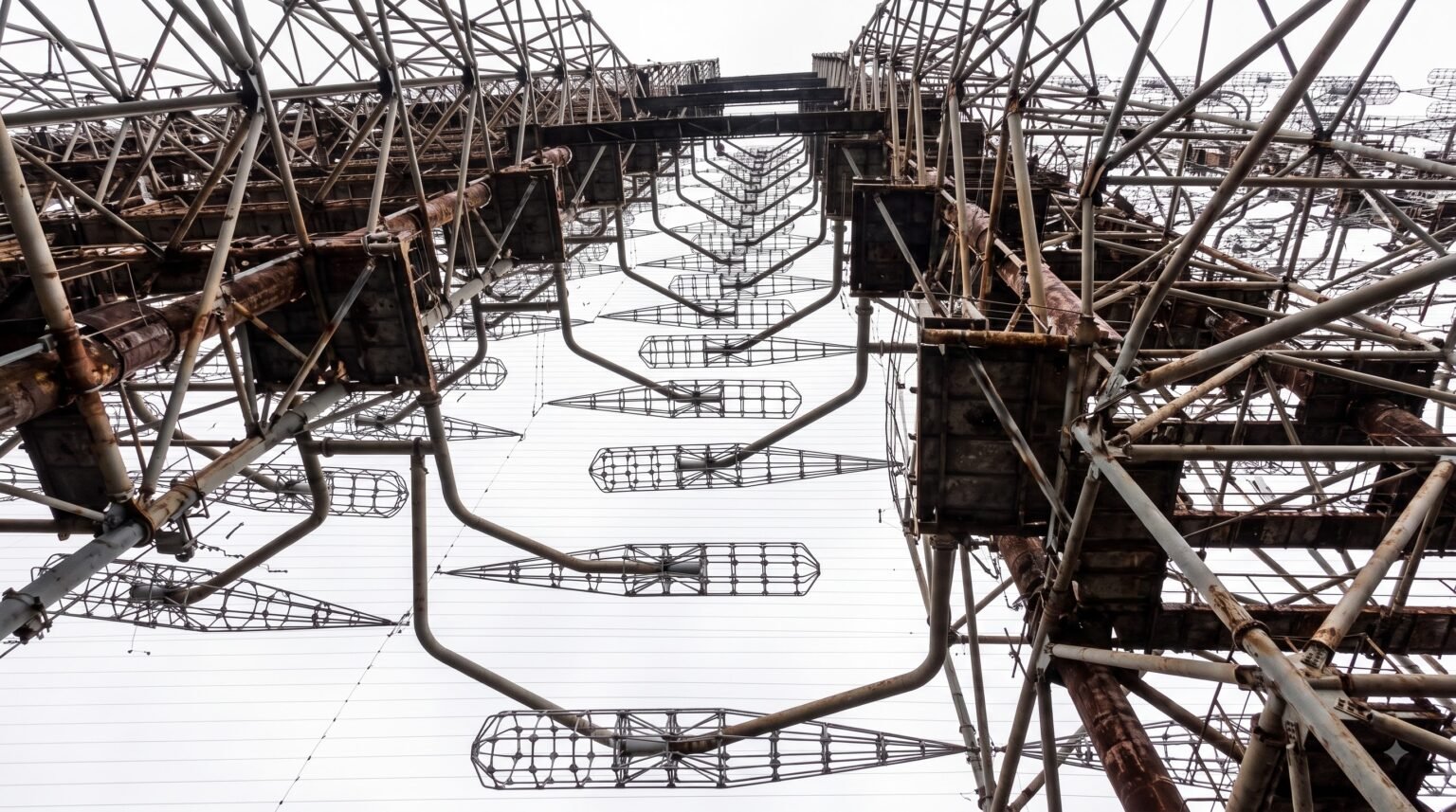
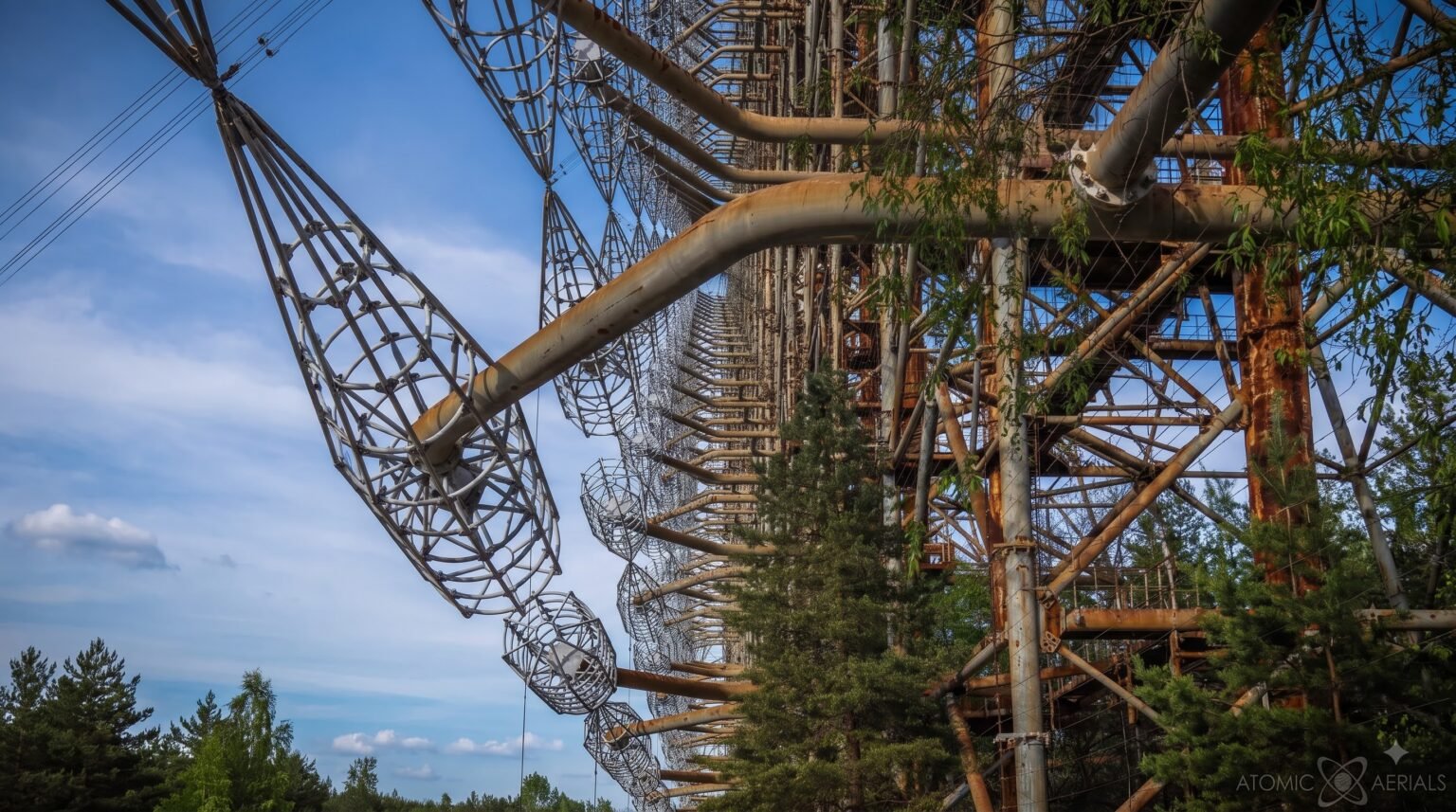
Move in closer, and texture takes over. Tubular pod fittings bolt along every lattice joint. Thick cable bundles snake in every direction.
Pipe fittings have rusted to the color of dried blood.
This does not look like a radio antenna anymore. It looks like the skeleton of something enormous.
Equal parts battleship, oil rig, and cathedral.
Inside the Control Room
Nearby, the control building still waits behind broken glass and peeling paint.
Step inside, and rows of consoles once buzzed here, tracking every pulse the antennas caught from across the world. Monitoring stations lined these walls day and night.
This was Soviet mission control. Built to watch not rockets already flying, but rockets about to leave the ground on the other side of the planet.
The military town carried that same singular purpose. A dedicated training academy taught new recruits the technical skills this machine demanded.
Propaganda rooms reinforced the mission on every wall. Technical classrooms held scale models of the very antennas trainees would soon operate, teaching the machine before anyone stood beneath the real one.
The Voice Behind the Static
None of this steel meant anything without the signal running through it.
At full power, Duga’s transmitters could push out an estimated 10 megawatts of EIRP – effective isotropic radiated power, in the language of radio engineers.
The system swept across frequencies between roughly 7 and 19 MHz, bands shared with ham radio operators, airline pilots, and emergency crews worldwide.
Later FCC analysis measured bandwidths as tight as 0.02 megahertz and as wide as 0.8.
That signature tapping, the sound that earned the Russian Woodpecker its name, came from a pulse compression technique built around a 31-bit Pseudo-Random Binary Sequence.
It typically repeated close to 10 times per second. Monitors sometimes logged faster patterns too, near 16 and 20 hertz.
Compressed into short, sharp bursts, that rhythm let the radar stretch its reach far beyond what raw power alone could ever achieve.
From July 1976 until December 1989, this exact combination of steel, power, and signal stayed live.
And it worked exactly as designed. The early proof at Mykolaiv had already shown the world something unsettling: over-the-horizon radar could catch a missile leaving the ground from distances no line-of-sight system could ever hope to match.
The One Warning Duga Never Received
April 26, 1986. Just after one in the morning.
Roughly ten kilometres away, reactor number four at the Chernobyl Nuclear Power Plant tore itself apart — the same power complex that had made this exact location so convenient for a power-hungry radar in the first place.
Duga’s antennas felt nothing. No blast, no fire, no falling debris reached this far. The steel stood exactly where it always had.
But the air around it had changed completely, and steel cannot read a Geiger counter.
Within a day, the order came down. Evacuate. Chernobyl-2, the hidden town built to keep this secret running, emptied out faster than it had ever filled.
Some engineers stayed behind a little longer, sheltering in underground bunkers, trying to preserve what they could of the equipment.
By the following year, even that resistance gave up. The last of the hardware was stripped out and hauled away, some of it reportedly shipped as far as Russia’s Far East.
Here’s the part that should sting a little. A machine engineered to give the Soviet Union thirty minutes of warning before annihilation had exactly zero minutes of warning for the disaster unfolding in its own backyard.
By the end of the 1980s, radio operators scattered across the globe noticed something strange in the silence. The tapping had stopped.
Nobody announced it. Nobody explained it. The Russian Woodpecker simply went quiet, and stayed that way.
A Town Frozen Mid-Sentence
Walk through Chernobyl-2 today, and you’re walking through a sentence nobody finished.
Apartment blocks stand with curtains still hanging in the windows. A cinema waits with its projection room intact. Classrooms hold desks still arranged for lessons that never resumed.
The old computer center carries its own particular chill. Row after row of server racks, stripped bare, cables hanging loose where machines were ripped free in a hurry.
For years, Soviet officials had cover stories ready for anyone who asked about the towering shape on the horizon. An unfinished hotel, curious outsiders were sometimes told. A children’s summer camp, according to the official maps.
Neither story survived contact with common sense, and rumor rushed in to fill the space official silence left behind.
Some whispered that Duga had somehow caused the disaster next door. Others speculated it was reading minds instead of missiles, earning it a second nickname: the Moscow Hidden Eye.
None of it was true. None of it needed to be, for the stories to spread anyway.
From State Secret to Silent Monument
Time did what secrecy never could. It made Duga famous.
Photographs of the rusting antenna field started circulating among a very particular kind of traveler, drawn to decay, silence, and stories nobody was supposed to know.
Ukraine folded the site into official guided tourism in the early 2010s, adding it to routes that already carried visitors past Pripyat‘s ferris wheel and the ruined plant itself.
For close to a decade, if you’d booked the right tour, a licensed guide would have walked you down that same concrete military road, dosimeters clicking, toward antennas that once listened for the end of the world.
Not everyone waited for permission. Unauthorized visitors have climbed sections of the antenna over the years, chasing exactly the pull that opened this article.
Some of those climbs have ended in serious injury. This is still a restricted, contaminated military site, not a playground.
Waiting Out Another War
This ground refuses to stay in the past tense.
Since Russia’s full-scale invasion of Ukraine began in 2022, the Chernobyl Exclusion Zone found itself back on a genuine front line rather than a Cold one.
Russian forces occupied the zone in the opening weeks of that war before withdrawing.
Licensed tours into the zone, Duga included, remain suspended today, paused until the security situation stabilizes enough for Ukrainian authorities to reopen the routes.
You won’t find a departure time for the next tour. Not yet.
The operators who once guided thousands of visitors a year through this exact forest are still standing by, waiting for that day. Nobody knows exactly when it comes.
Until then, the antenna keeps doing the one thing it has done well for the last four decades. It waits.
Rust spreading a little further every year. Forest closing in a little tighter every season.
A machine built to detect a threat arriving from the sky, standing silent guard over a war that arrived instead from the ground.
The Slow Collapse Behind the Sudden One
The story everyone tells about Duga’s end starts and stops with one date: April 26, 1986. That’s not the whole story.
Long before the reactor exploded, this machine was already losing a much quieter fight.
Over-the-horizon radar depends on one deeply unreliable partner: the Ionosphere itself. Signals need that charged layer of atmosphere to behave predictably, bouncing back down exactly where engineers expect them to land.
The Ionosphere never agreed to those terms. It shifts with the sun, the season, the hour of the day, thinning and thickening in ways no engineer could fully tame.
The result: the operational array pointed north, the one built to watch for American missiles, never became the dependable early-warning system its designers promised the Kremlin.
It worked. It just didn’t work reliably enough to trust with the end of the world.
Engineers knew this. By the mid-1980s, they were running trials on an upgraded version, trying to wrestle a little more consistency out of an atmosphere that refused to cooperate.
Then April 26, 1986 happened, roughly ten kilometres away, and those trials simply stopped. Nobody ever finished them.
Chernobyl-2, the military town built to support all of it, emptied out along with everyone else forced from the wider exclusion zone.
The wider Duga Radar project didn’t vanish overnight.
Its twin installation, built to the same design far to the east in Soviet Russia, kept working a few years longer. By 1989, that sister site went dark too, closing the book on the entire program at almost the same moment the Cold War itself was ending.
Satellites had already started doing this job better anyway.
Faster to build, harder to jam, and nowhere near as visible as 150 metres of steel screaming its presence into every open horizon.
Add in a collapsing Soviet economy that could no longer justify the program’s staggering cost, and Duga Radar’s fate was sealed from more directions than just one wrecked reactor.
The Half That Didn't Survive
Not every piece of this system survived the shutdown equally.
The transmitter half of the array, built near the village of Rozsudiv, lost its antenna structure entirely somewhere along the way.
Only the receiver field, the one you’re standing in front of, made it through intact.
Contamination is the reason why. Stripping this ground down would have meant sending workers into radiation levels nobody wanted to justify for scrap metal.
So the structure simply stayed.
Rusting quietly, becoming, without anyone planning it, one of the most complete Cold War ruins left standing anywhere on Earth.
Visitor Information
| Location | Chernobyl Exclusion Zone, Kyiv Oblast, Ukraine |
| Current Access | Tours currently suspended due to the ongoing security situation in Ukraine |
| Best Time to Visit | Spring and Autumn (when tours resume) |
| Entry Requirements | Authorized guided tour and official permission required |
| Independent Access | Not permitted |
| Nearest City | Kyiv |
| Walking Distance | Moderate walking over uneven terrain |
| Photography | Permitted on guided tours unless otherwise instructed |
| Accessibility | Not wheelchair accessible; uneven surfaces throughout |
| Approximate Duration | 2–4 hours as part of a full Chernobyl Exclusion Zone tour |
| Nearby Attractions | Pripyat, Chernobyl Nuclear Power Plant, Red Forest, Duga Control Building |
| Visitor Safety | Follow guide instructions, remain on designated routes, and comply with radiation safety protocols |
Visiting the Duga Radar Today
Here’s the honest part first.
For the better part of a decade, reaching this spot was a bookable, if bureaucratic, experience. Right now, it isn’t.
Organized tours into the zone remain paused while the war along Ukraine‘s northern border continues, and no responsible operator is promising a date for when that changes.
Everything that follows describes how this visit works, has worked, and will work again once the gates reopen.
Today, the Duga array stands as one of the most famous abandoned military structures anywhere inside the Exclusion Zone.
You do not get to wander in on your own. Access here is tightly controlled, checkpoint by checkpoint, and independent movement inside the zone simply isn’t allowed.
A licensed guide leads every step. A dosimeter clips to your jacket before you go anywhere near the perimeter.
Time limits and location limits, set by Ukrainian authorities, decide exactly how long you get and exactly where you’re permitted to stand.
In practical terms, that means booking an authorized tour out of Kyiv, or folding this stop into a longer, multi-day itinerary through the wider zone.
The drive in follows Soviet-style concrete road slabs, prefabricated decades ago, cutting a straight grey line through dense forest.
Eventually, the vehicle stops, and the rest of the approach happens on foot.
Trees swallow the horizon on every side.
Whatever you know about this place from photographs, none of it prepares you for how completely the forest hides the scale of it until you’re almost underneath the thing.
Silence takes over out here. Not peaceful silence. The kind that makes you notice every sound you make yourself.
In cold weather, the whole structure adds its own soundtrack: metal clacking, joints creaking, the framework contracting and groaning like it’s still deciding whether to stay standing.
Packing for a Cold War Ruin
Dress like the season actually is here, not like the photos you’ve seen online.
Winters at this latitude cut straight through anything less than proper insulated layers, and summers bring their own share of mud and biting insects.
Good boots matter more than almost anything else you’ll pack.
The ground is uneven, frozen or muddy depending on the month, and you’ll be on your feet for hours.
Bring gloves warm enough to wear while still operating a camera, because you will regret peeling them off every time you want a shot.
Speaking of cameras: interiors here are dark, cluttered, and unforgiving of slow settings.
Whatever you shoot with needs to handle low light well, and you need to operate it fast. Guides move groups along on a schedule, not on your creative timeline.
Pack light. You carry everything yourself, the whole way in and the whole way back out.
On foot, over uneven ground, with a dosimeter clicking the entire time to remind you exactly where you are.
Inside the Ghost Town
Past the antenna field, Chernobyl-2 waits in its own kind of silence.
Prefabricated apartment blocks stand in orderly rows, windows dark, paint peeling in long vertical strips.
A playground rusts quietly between buildings, swings frozen mid-motion by nothing more than decades of stillness.
The school still holds its shape. Small chairs, low desks, chalkboards nobody erased. A gymnasium down the hall, and further along, what was once an entertainment center for the families who lived here.
Inside the control buildings themselves, the atmosphere shifts again. Propaganda murals still cover long stretches of wall, painted slogans faded but legible.
Cabinets of stripped electronics line the corridors.
Training rooms sit exactly as they were left, chairs facing forward, waiting for lessons that ended the same week the whole town did.
None of this is wild, unsupervised urban exploration, whatever the photographs might suggest.
Every step happens on a managed route, inside a monitored radiation zone, under the authority of guides who know exactly which floors are safe to stand on.
Call it what it actually is: controlled dark tourism, dressed in the aesthetics of abandonment.
That distinction doesn’t make the place any less extraordinary.
Military history. Radio history. Nuclear disaster memory, urban exploration culture, decades of pop culture fascination.
All of it converges on this one patch of forest, around one silent steel giant.
It was built to listen for the end of the world. Instead, it became a monument to something else: how quickly the future can turn into a ruin.
The Final Verdict on Duga Radar
Stand back and look at the whole shape of this story, and something strange comes into focus.
Duga Radar was never really defeated by an enemy.
It was defeated by the sky it was built to read, and then, cruelly, by the ground it never thought to watch.
A machine engineered to give the Soviet Union thirty minutes against apocalypse ended up standing helpless against an apocalypse that started ten kilometers from its own front door.
And yet here it still is. Rusting, yes. Silent, yes. But still standing, decades after the empire that built it disappeared entirely.
That’s the part that makes this place different from most abandoned military sites.
Most of them get demolished, sold for scrap, erased. Duga survived by accident, preserved by the same contamination that killed it.
Call it tragic. Call it awe-inspiring.
Most people who have stood here would say it’s both at once, and that the two feelings never fully separate.
You came here for a story about a radar.
You leave with something closer to a monument: to fear, to ambition, to the strange durability of things built to watch for the end of the world.
So here’s the question worth sitting with, long after you’ve left the tree line behind: when the world finally gets around to opening this gate again, will you be the one walking through it?
There’s always another ruin worth chasing before then.
Bookmark and subscribe to roastedbum.com to get more updates on astonishing historical deep dives.
Disclaimer: The content on Roasted Bum is published strictly for historical, architectural, and educational purposes. We do not condone, encourage, or provide instructions for trespassing, bypassing security, or entering restricted, abandoned, or hazardous properties. Urban exploration carries severe legal consequences and life-threatening physical risks, including structural collapse, toxic exposure, and unexploded ordnance. Do not attempt to visit or enter any restricted locations described on this website. Any actions taken by readers based on this content are entirely at their own personal and legal risk.